Budgeting, Forecasting & FP&A
Turn financial data into a forward-looking plan for your business.
ICA Light helps businesses develop budgets, forecasts, scenarios, and financial models that connect operational assumptions to expected financial results. The goal is not simply to predict the future. It is to give management a structured way to understand what may happen, test alternatives, identify risks, and make better-informed decisions before conditions change.
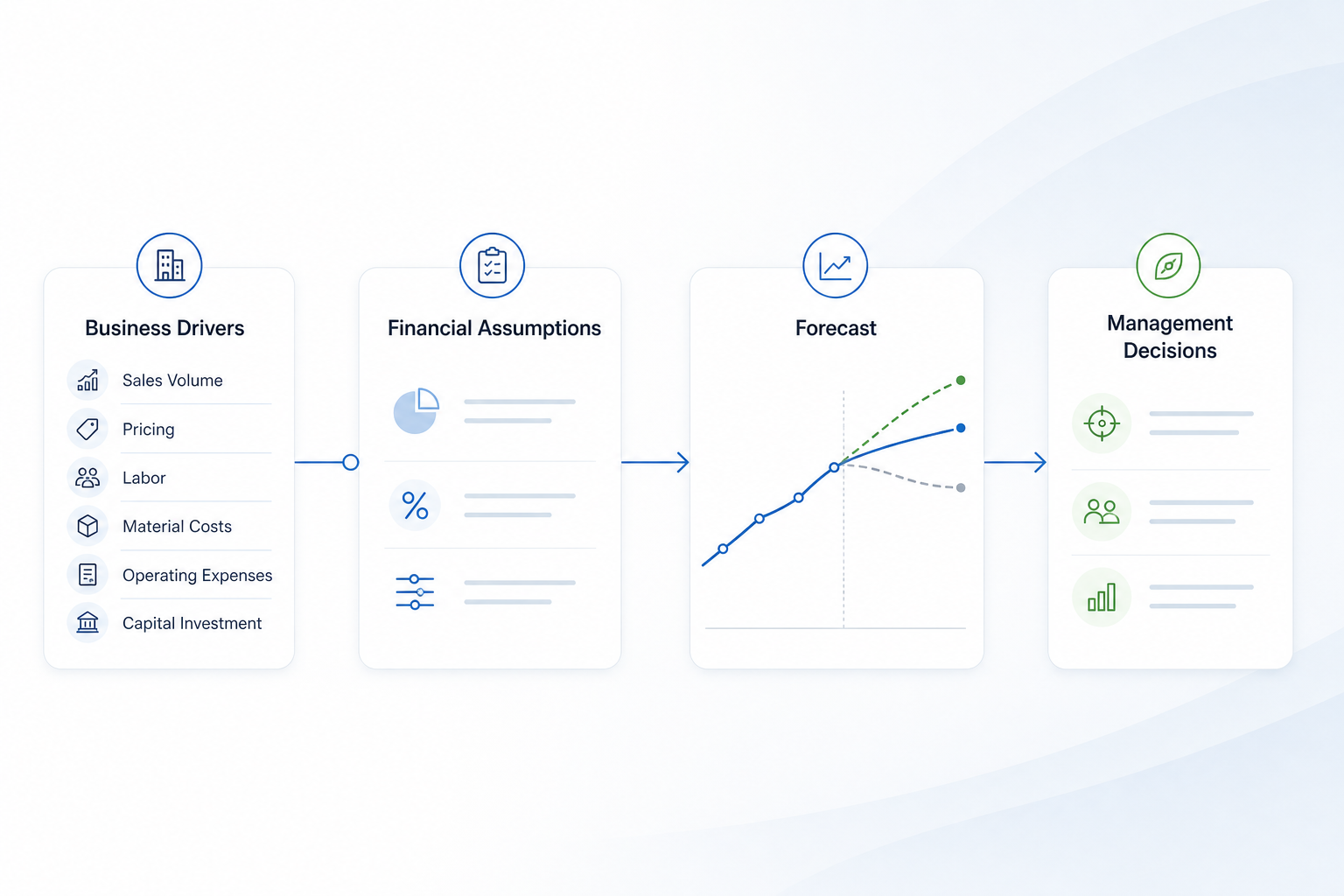
From Reporting to Planning
Financial reporting shows where the business has been. FP&A uses those results, together with operating assumptions and management expectations, to build a view of where the business may be going.
ICA Light helps connect historical results to the operational drivers behind the business so management can evaluate expected performance, identify emerging risks, test alternatives, and make decisions before the financial results are already recorded.
01 · HISTORICAL RESULTS
Understand What Happened
Revenue, gross margin, operating expenses, cash flow, and actual results establish the starting point.
02 · BUSINESS DRIVERS
Identify What Moves Performance
Sales volume, pricing, headcount, labor utilization, material costs, customer activity, and production levels shape financial outcomes.
03 · ASSUMPTIONS
Translate Expectations Into Inputs
Expected growth, hiring plans, cost and pricing changes, capital expenditures, and timing assumptions define a structured view of what may happen.
04 · FORECAST
See the Financial Impact
Project the effect of those assumptions on revenue, profitability, cash, and working capital across future periods.
05 · MANAGEMENT DECISIONS
Prepare and Act
Use the forecast to evaluate choices such as hiring, investment, pricing, cost actions, spending timing, and growth opportunities.
Reporting tells you where you are. Planning helps you decide where to go next.
Budgeting Built Around the Business
Build the financial plan from the operating assumptions that actually drive results.
ICA Light helps businesses develop budgets around the drivers that influence revenue, costs, staffing, investment, and cash flow. By connecting financial expectations to operating assumptions, management can better understand what must happen for the plan to work—and recognize when actual performance begins moving away from that plan.
REVENUE
Volume × Price → Revenue
Model customers, units sold, jobs completed, billable hours, pricing, and product or service mix at the level that matters for the business.
LABOR
Headcount × Compensation or Hours → Labor Cost
Connect planned hires, wage rates, overtime, productivity, and staffing levels to expected labor requirements.
MATERIALS & COST OF SALES
Volume × Input Requirements × Cost → Material Cost
Use production or sales volume, material usage, vendor pricing, freight, waste, and yield assumptions where they meaningfully affect results.
OPERATING EXPENSES
Connect Spending to the Operating Plan
Model meaningful expenses around locations, vehicles, software, marketing, insurance, contracted services, and growth initiatives. Other expenses may appropriately use trends, contracts, or management estimates.
CAPITAL INVESTMENT
Planned Investment → Cash, Financing & Capacity
Reflect equipment, vehicles, technology, facilities, and other capital expenditures along with their effects on cash, depreciation, financing, and future operating capacity.
SIMPLIFIED FINANCIAL PLAN
Revenue → Gross Profit → Operating Income → Cash Requirements
The budget brings the model together so management can see how key operating assumptions affect expected financial performance and cash needs.
Model what matters. A driver-based budget helps management see what needs to happen, what resources the plan requires, where the plan is most vulnerable, and whether actual performance is tracking to plan. The level of detail should fit the business; the goal is to make assumptions visible and useful—not to create complexity for its own sake.
Keep the Financial Outlook Current
Update the forecast as the business changes, instead of managing the rest of the year from assumptions made months ago.
ICA Light helps businesses maintain rolling forecasts that incorporate actual results, updated operating assumptions, and changes in management expectations. This gives management a current view of expected revenue, profitability, cash flow, and financial needs as conditions change throughout the year.
ANNUAL BUDGET — ORIGINAL PLAN
JAN | FEB | MAR | APR | MAY | JUN | JUL | AUG | SEP | OCT | NOV | DEC
ROLLING FORECAST — CURRENT OUTLOOK
ACTUAL RESULTS → UPDATED FORECAST → PLANNING HORIZON EXTENDS FORWARD
The budget remains the benchmark. As each month closes, another period becomes actual and the remaining outlook is refreshed using current information.
Actual Results → Review Business Drivers → Update Assumptions → Refresh Forecast → Evaluate Expected Results → Management Decisions ↻
01 · REVENUE
Update the Expected Top Line
Revise the outlook as sales volume, pricing, customer demand, and product or service mix develop differently than expected.
02 · COSTS
Reflect Current Cost Conditions
Update material pricing, labor rates, vendor costs, and operating expenses as new information becomes available.
03 · STAFFING
Adjust for Hiring and Capacity
Reflect changes in hiring timing, headcount, overtime, compensation, and staffing requirements.
04 · INVESTMENT
Keep Spending Plans Current
Update equipment purchases, expansion plans, technology investments, and project timing as priorities or conditions change.
05 · CASH
Maintain a Current Liquidity View
Reflect customer collections, vendor payment timing, inventory requirements, capital spending, and financing needs.
BUDGET
What did we plan to happen?
The budget is the original financial plan and remains the benchmark for measuring performance.
FORECAST
What do we now expect to happen?
The forecast incorporates current information and updates the expected financial outlook. It does not replace the budget.
Given what we know today, where are we now likely to finish?
A current forecast helps management evaluate whether the plan is still achievable, how expected cash is changing, whether hiring or capital plans remain affordable, when financing or liquidity may be needed, and whether pricing, spending, or operating plans require attention.
With a current forecast in place, management can then evaluate how the outlook could change when important assumptions move.
Test the Decisions Before You Make Them
Evaluate how different assumptions could affect profitability, cash flow, and financial capacity before committing to a course of action.
ICA Light helps businesses build scenarios around the assumptions that matter most. Management can compare different outcomes, identify where the financial plan is most sensitive, and better understand the risks and opportunities behind important decisions.
DOWNSIDE CASE
What if conditions develop worse than expected?
Test lower sales volume, higher material costs, slower collections, delayed customer activity, or greater labor requirements against revenue, margin, operating income, cash flow, ending cash, and financing needs.
BASE CASE
What does management currently expect?
Use the current forecast and most likely operating assumptions as the central view for comparison across revenue, profitability, cash flow, ending cash, and financial capacity.
UPSIDE CASE
What if conditions develop better than expected?
Test higher sales, improved pricing, stronger margins, faster collections, or greater capacity utilization to understand the opportunity and the resources required to support it.
SENSITIVITY ANALYSIS
Which assumptions matter most?
Test one change at a time: sales volume ±10%, material costs +5%, a hire three months earlier, customers paying 15 days later, or equipment purchased now instead of six months from now.
DECISIONS TO TEST
Put Real Management Choices Into the Model
Evaluate hiring, pricing, capital investment, growth, and cost pressure before committing cash, adding capacity, changing prices, or taking on financing.
RISK & OPPORTUNITY
Understand Where Management Has Room to Act
Scenario analysis can test downside exposure and opportunities such as expansion, accelerated hiring, additional debt, a large new customer, more inventory, or earlier investment in equipment or technology.
Assumption Change → Financial Impact → Management Response
Scenarios do not predict what will happen. Their value is showing which assumptions matter most, how large the potential impact could be, and what management could do if conditions change.
Before making an important decision, understand how the economics could change under different assumptions.
Plan for Cash, Not Just Profit
Understand when cash is expected to come in, where it is expected to go, and whether the business has enough liquidity to support the plan.
ICA Light helps businesses connect operating forecasts to expected cash flow. By modeling collections, payments, working capital, debt service, capital spending, and other major cash requirements, management can see potential liquidity needs before they become immediate problems.
01 — SALES & OPERATIONS
How much cash do we expect to have?
Revenue, gross margin, operating expenses, payroll, and other recurring costs establish the operating activity that will ultimately affect cash.
02 — WORKING CAPITAL
What happens if collections slow?
Accounts receivable, accounts payable, inventory, customer deposits, and vendor-payment timing determine when operating activity becomes cash.
03 — OPERATING CASH FLOW
When could liquidity become tight?
Expected collections and payments translate the operating forecast into cash inflows and outflows, revealing periods where reserves may fall below management’s comfort level.
04 — DEBT & CAPITAL SPENDING
Can we afford the investment?
Principal payments, interest, equipment purchases, facility investment, technology spending, hiring, and expansion add important cash requirements beyond normal operations.
05 — EXPECTED CASH POSITION
Will growth require financing?
Projected ending cash shows whether planned growth can be supported, where liquidity may strengthen or tighten, and when additional working capital could be required.
FINANCIAL FLEXIBILITY
When should financing be arranged?
Expected cash, available credit, and other funding capacity help management understand financial flexibility and prepare early—without treating borrowing as the default solution.
Opening Cash + Expected Cash Inflows − Expected Cash Outflows = Ending Cash
More sales do not always mean more immediate cash. Growth may require inventory purchases, new employees, extended customer terms, equipment, or larger receivable balances before the related cash is collected. Cash needs can rise even while revenue and profit are growing.
Cash-flow forecasts are not exact. Collections, payments, operating activity, and unexpected events can differ from assumptions. Their value is visibility and preparedness.
A business should understand its expected cash position before making commitments that depend on that cash being available.
Plan Around the Drivers That Matter
Connect the financial forecast to the operating activity that actually produces the result.
The financial statements show the result. The business drivers explain what creates that result. ICA Light helps businesses identify the operational drivers with the greatest effect on revenue, costs, margins, working capital, and cash flow—so management can understand why results are changing and where attention should be focused.
REVENUE
Volume × Price → Revenue
Units sold, customers, jobs completed, billable hours, average selling price, and product or service mix explain how operating activity becomes revenue.
LABOR
Headcount × Compensation / Hours → Labor Cost
Staffing levels, wage rates, overtime, productivity, and utilization connect workforce decisions to cost, capacity, and margin.
MATERIALS / COST OF SALES
Volume × Input Requirement × Unit Cost → Material Cost
Units produced, material consumption, yield, waste, vendor pricing, and freight show how production activity affects cost and margin.
WORKING CAPITAL
Sales & Purchasing Activity → AR / Inventory / AP → Cash
Customer payment timing, inventory levels, purchasing volume, vendor terms, and collection performance explain how operating activity affects cash.
CAPITAL INVESTMENT
Growth or Capacity Needs → Investment → Cash & Financing
Production capacity, expansion, replacement cycles, project timing, and financing structure connect operational needs to equipment, facilities, technology, and financial capacity.
MANAGEMENT UNDERSTANDING
What Is Actually Causing the Change?
Driver-based planning helps management identify which assumptions matter most, what operating measures to watch, where action is possible, and how changes in volume, pricing, labor, cost, or timing affect profit and cash.
Operating Activity → Business Drivers → Financial Results → Cash Impact → Management Understanding
Not every variable deserves the same level of attention. The material drivers may be labor utilization, customer volume, pricing, material costs, inventory, capacity, project timing, seasonality, or something specific to the business. The objective is to focus the forecast on the few variables that materially affect financial performance.
Understand the drivers → Understand the financial impact → Use that understanding to make better decisions.
Financial planning becomes more useful when management can see the connection between what is happening in the business and what ultimately happens to revenue, profit, and cash.
Turn Financial Planning Into Better Decisions
Use the forecast, scenarios, and business drivers to understand the financial impact of important decisions before committing to them.
ICA Light helps management test assumptions, compare alternatives, and understand the expected impact on profitability, cash flow, and financial capacity. FP&A supports management judgment by making the tradeoffs behind hiring, pricing, investment, growth, cost, and financing decisions more visible.
HIRING
Can the Business Support the Hire?
Test when the hire should occur, what revenue or productivity improvement is needed, and how payroll, benefits, capacity, revenue, and cash flow may change before the benefit is realized.
PRICING
What Happens if Prices Change?
Evaluate volume sensitivity and different customer, product, or service economics to understand the potential effect on revenue, gross margin, customer mix, and cash generation.
CAPITAL INVESTMENT
Should the Investment Happen Now or Later?
Compare timing, expected capacity or cost improvement, and financing versus cash to understand the effect on liquidity, debt, depreciation, capacity, and operating costs.
GROWTH
What Will Higher Sales Require?
Estimate additional inventory, receivables, labor, equipment, capital spending, and financing needs to see how much cash may be required before growth becomes self-funding.
COST MANAGEMENT
Which Savings Materially Affect the Forecast?
Identify the costs driving pressure, the savings that matter, and the operational consequences to understand effects on margin, capacity, service levels, cash flow, and future growth.
FINANCING
How Much Capacity Is Needed—and When?
Test the amount and timing of financing, supportable debt service, and the resulting effect on cash availability, interest, principal payments, debt capacity, liquidity, and future flexibility.
Management Question → Financial Analysis → Expected Impact → Decision
Forecast + Scenario Analysis + Cash Planning → Better-Informed Management Decision
Most important decisions involve tradeoffs. Growth can increase working-capital needs. Hiring can add capacity while reducing short-term cash. Equipment can lower operating costs while requiring capital. Higher prices can improve margin while affecting volume. Cost reductions can improve profitability while limiting capacity.
ICA Light provides financial analysis, structured assumptions, scenario comparisons, expected financial impacts, and decision support. Management remains responsible for deciding what the business should do.
The purpose of FP&A is to give management a clearer financial view of the choices being considered and the tradeoffs those choices may create.
Make Planning an Ongoing Management Process
Use actual results to update assumptions, refine the forecast, and keep financial planning connected to the decisions management is making.
ICA Light helps businesses create a disciplined planning process that evolves with actual performance and changing conditions. Rather than building a budget once and setting it aside, management can compare results to expectations, update material assumptions, refresh the forecast, and use the current outlook to support deliberate decisions.
01 — ACTUAL RESULTS
What Actually Happened?
Compare current performance with the budget, the latest forecast, prior periods, and operating expectations to establish the next planning starting point.
02 — UNDERSTAND THE DRIVERS
Why Did Results Differ?
Review volume, pricing, labor, materials, customer timing, and operating activity to understand what created the difference between expectations and results.
03 — UPDATE ASSUMPTIONS
What Has Changed?
Revise material assumptions for sales, hiring, costs, capital spending, customer collections, and growth plans when the underlying facts change.
04 — REFRESH THE FORECAST
What Does the Current Outlook Look Like?
Update expected revenue, profitability, cash flow, working capital, and financial needs. The original budget remains the benchmark; the forecast provides the current outlook.
05 — EVALUATE DECISIONS
What Should Management Adjust?
Use the refreshed outlook to deliberately evaluate hiring, pricing, spending, investment, financing, and growth plans when conditions materially change.
06 — MEASURE NEW RESULTS
What Information Comes Next?
As decisions take effect, new operating and financial results provide the next set of information. Management reviews the outcome, learns, and begins the cycle again.
Actual Results → Updated Assumptions → Forecast → Management Decisions → New Results → Repeat
Budget is the original plan. Actuals show what happened. Forecast shows what management currently expects. The three work together rather than replacing one another.
The right planning cadence depends on the business. Monthly review may be appropriate for some organizations; faster growth, major investment, liquidity pressure, or significant change may warrant more frequent attention. The objective is useful visibility—not constant reforecasting or reacting to every short-term variance.
Earlier Visibility · Better Accountability · Faster Response · Better Resource Allocation · More Informed Decisions
FP&A is an ongoing process of comparing results to expectations, updating assumptions, refining the outlook, and using current information to support better management decisions.
FORWARD-LOOKING FINANCIAL PLANNING
Build a Financial Plan That Moves With the Business
Turn budgets, forecasts, and financial models into a practical management process for understanding what may happen next and preparing for it.
ICA Light helps businesses build financial planning processes that connect operating assumptions to expected financial results. Whether the need is an annual budget, a rolling forecast, scenario analysis, cash planning, or a broader FP&A process, the goal is to give management clearer visibility into the financial impact of the decisions ahead.
Better planning helps management prepare for uncertainty.